How to keep up to date with releases - why I built Releases.news

It’s no secret that things move very fast in the world of web development. Updates to popular languages, libraries and frameworks are released all the time. It can be daunting to keep up.
For a while now, I’ve subscribed to the release feed emails for numerous GitHub repositories (e.g. https://github.com/withastro/astro/releases), and I’ve found it to be a decent way to keep up to date. I feel like I have a finger on the pulse of what’s happening (probably some unresolved control issues here, but hey ho). However, it always felt unfocused to have these show up in my email inbox, and jarring to process them together with other types of information. Yes, I used filtering, multiple inboxes, etc. to manage them, but it still felt like a lot of noise, and like it was in the way.
And that’s why I’ve built Releases.news — a place to keep up to date with releases from popular web development languages, libraries and frameworks.
How it works?
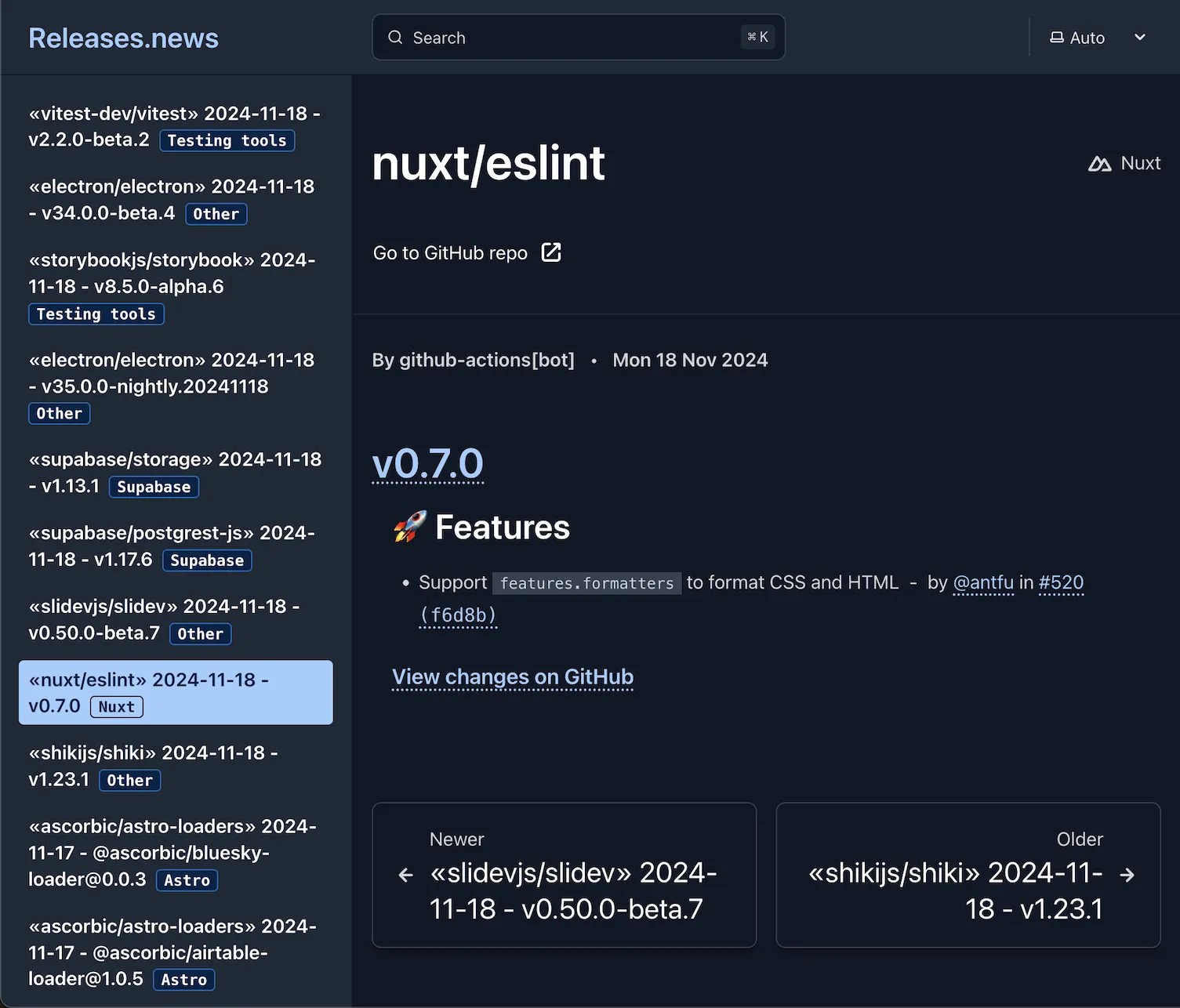
Section titled “How it works?”Starting very simple, it’s a place where feeds from many GitHub repos are aggregated and displayed in a clean, focused and easily browse-able fashion — a single list that I can easily scan to read the releases notes and changelog items coming through from the GitHub repos.
I’ve started with a bunch of feeds of popular web development languages, libraries and frameworks — ones that I use and try to keep on top of. The goal is to keep this list as small as reasonably possible, and to keep the focus on the most popular and widely used tools. You can find the full list of feeds on the homepage (scroll down a bit).
It is not intended to be a complete historical record — only entries returned from the GitHub releases feeds for the repositories listed below are shown, and only for the last 30 days.
With easy navigation between the time-ordered entries, via the pagination links at the bottom of each page, I can leave the browser tab open and refresh it periodically to continue where I left off last (using the “Newer” navigation link).
I’ve now unsubscribed from most of the release feed emails and use Releases.news every day! 🎉
Tech stack
Section titled “Tech stack”I’m a huge fan of Astro and Cloudflare Pages, and together with the Astro Starlight template and the Astro feed loader I was able to build Releases.news in a few days and ship it.
Whilst starlight is designed for documentation sites, I found that I could use it as an excellent foundation for a feed aggregator site. I quite like the design, set up, structure and components that Starlight comes with, out of the box. I use it to build this dev website and blog too! There is a caveat: because Starlight is not designed to be a completely flexible and modular website solution (as is fair for its purpose) it can be a bit of a pain to customise and extend, and there’s no guarantee that future updates to Starlight won’t break things (as I’ve already seen with a breakage just today, when upgrading to the latest version). It’s worth noting that I don’t use any of the default content loading set up that Starlight comes with — I’ve replaced it with my own implementation, building on the (soon to be stabilised) Astro Content Loader API, and a custom page that uses the <StarlightPage> component to render each feed entry page.
The website is completely static, and all feed data is fetched at build time. A scheduled GitHub Action runs every 2 hours, which triggers the Cloudflare Pages build (via a web hook). This does mean that the site is not real-time, but I think that’s fine for this use case (checking things a few times a day).
Would you find something like this useful? Are you interested in hearing more about the internal implementation details? Do reach out. I’m always happy to chat about this stuff.